

Teams do better work when they can answer a simple question quickly: what do we already know, and why do we know it?
That is the promise of company memory. Not a dusty archive. Not a pile of meeting notes no one can find. Company memory is the living record of decisions, context, patterns, and constraints that help a team act with confidence.
It matters even more now because AI is moving from novelty to daily utility. Recent industry survey data has shown knowledge management among the most common AI use cases, while many organizations are already experimenting with AI agents. That shift raises the bar. If the underlying memory is thin, scattered, or unreliable, AI will repeat the same weakness at machine speed. If the memory is grounded, reviewed, and permission-aware, AI becomes far more useful.
What company memory means in practical terms
Company memory is the shared context that helps people and systems work with the same facts. It includes the obvious things, like policies and project docs, and the less obvious things, like why a roadmap changed, which customer requests shaped a feature, what risks were accepted, and what a team learned after a launch.
A lot of teams already have pieces of this memory. The problem is fragmentation. Key facts sit across chat threads, private notes, issue comments, slide decks, onboarding docs, and individual recall. People can feel informed in the moment while the organization becomes less legible over time.
That gap shows up in small ways first, then expensive ones later.
A useful way to think about company memory is as durable workspace state. Instead of letting important context disappear into conversation, a team captures it where work happens and where others can review it later. In that model, memory is not separate from execution. It is part of execution.
Why shared company memory improves team execution
Execution improves when teams spend less time reconstructing the past. A strong memory system reduces repeated debates, shortens handoffs, and gives people a clearer starting point for action.
Research on team performance helps explain why. Studies of transactive memory systems, the shared awareness of who knows what and where knowledge lives, have linked that shared structure to stronger team performance. When people know where expertise sits and can access the reasoning behind earlier decisions, coordination gets easier. Work does not stall every time a key person is offline or leaves the company.
Project memory also cuts down on rehashing. Teams stop solving the same problem every quarter. New hires ramp faster because the story behind the record is available, not hidden in hallway history or old calls.
When company memory is healthy, teams tend to gain a few practical advantages:
- Faster handoffs
- Fewer duplicate decisions
- Clearer ownership
- Shorter onboarding cycles
- Better cross-functional coordination
None of this is glamorous. It is simply what reliable execution looks like.
What weak company memory looks like inside a team
Weak memory rarely announces itself. It shows up as drag.
A product manager asks why a feature was deprioritized six months ago. No one is sure. A support lead remembers a customer promise that never made it into the roadmap. An engineer rebuilds an integration pattern because the earlier approach is buried in an old thread. A new teammate reads the docs and still cannot tell which version of the truth matters.
The cost is not only wasted time. Weak memory creates inconsistent decisions. People act on partial context, fill gaps with assumptions, or ask AI tools questions the workspace cannot answer well.
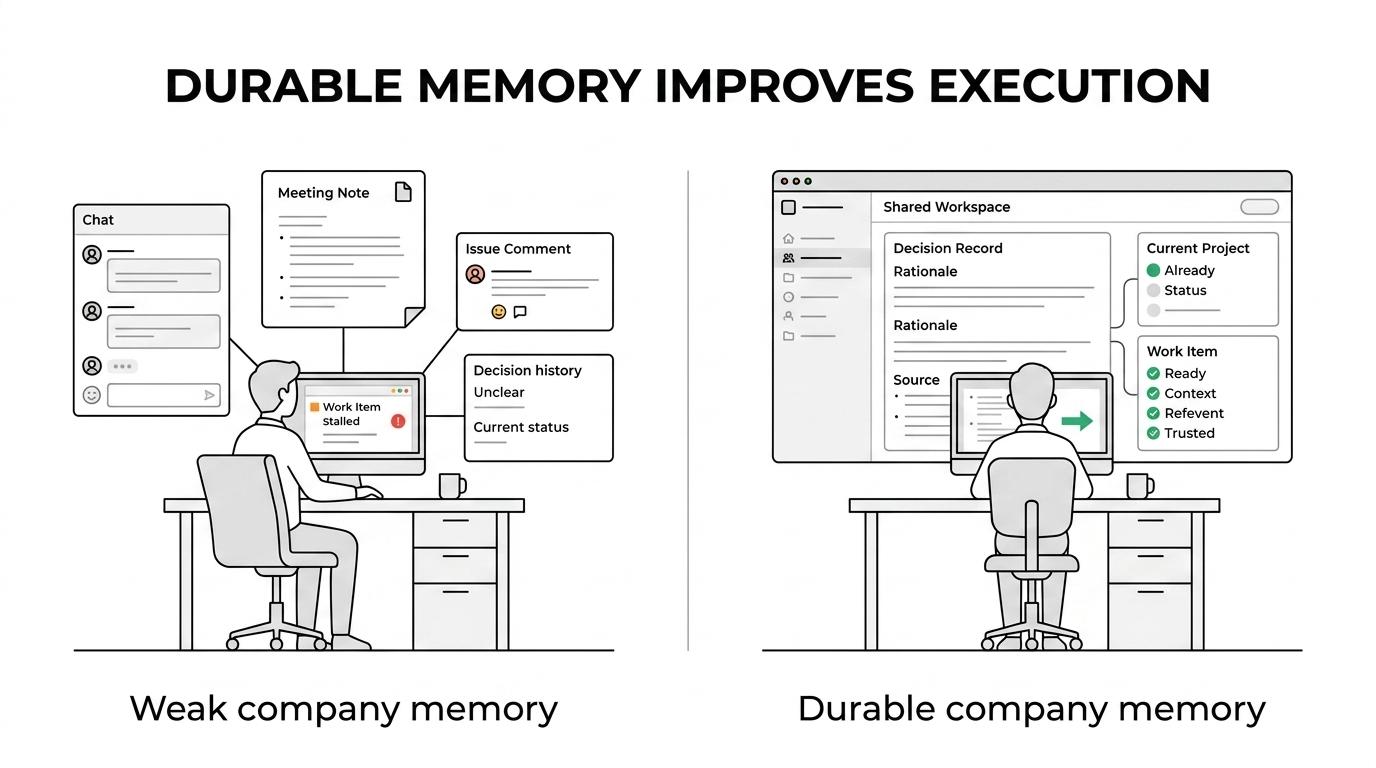
The difference becomes clear when you compare the two states side by side.
| Team signal | Weak memory | Durable company memory |
|---|---|---|
| Decision history | Scattered across chats and meetings | Captured with rationale and references |
| Project status | Depends on who is online | Visible in shared workspace state |
| Onboarding | Oral tradition and scattered docs | Structured context with reusable paths |
| Search results | Many hits, low trust | Fewer hits, higher relevance and traceability |
| AI answers | Generic or speculative | Grounded in approved context |
| Governance | Hard to know who can see what | Retrieval follows workspace permissions |
That last row matters more than many teams expect.
Why company memory is now central to AI use
AI is only as useful as the context it can access safely and accurately. If the source material is vague, stale, or missing, the model can still produce polished language, but polished language is not the same thing as trusted work.
This is one reason knowledge management has become such a prominent AI use case. Teams want AI to answer questions, summarize project status, draft plans, surface prior decisions, and suggest next steps. Those are all memory-heavy tasks.
The challenge is simple: AI needs more than documents. It needs context that is current, reviewable, and scoped correctly. A helpful answer often depends on the reason behind the record, not just the record itself. A roadmap item means something different if it was delayed for compliance, customer timing, technical risk, or a strategic shift.
That is where a memory-aware workspace changes the result. Instead of pulling from a generic data dump, AI can retrieve from relevant projects, docs, check-ins, and approved memory within the user’s allowed scope. Better retrieval leads to better assistance.
For AI work that affects plans, tickets, or docs, a few design choices matter most:
- Grounding first: Retrieval should come before generation so the model starts from workspace facts.
- Permission-aware access: Answers should reflect what the user is allowed to see, not everything the system has indexed.
- Source trail: People should be able to inspect the references behind an answer.
- Human review: Proposed memory, edits, and actions should not become canonical without a person approving them.
This is the difference between AI as a guess machine and AI as a useful teammate.
Why human review keeps company memory trustworthy
A common mistake is assuming that once AI can summarize or extract, memory maintenance becomes automatic. In practice, durable memory still needs editorial judgment.
Generated summaries can omit nuance. Extracted decisions can flatten debate into false certainty. Suggested tickets can sound correct while missing a key dependency. If those outputs become permanent records without review, the memory system degrades quietly.
A better model treats AI as an assistant for drafting, organizing, and retrieving, while people retain authority over what becomes official. Review does not slow things down as much as many expect. It often speeds work up because the team trusts the result and does not need to re-verify every answer from scratch.
This is especially important for consequential changes. A proposed roadmap update, a new policy summary, or a memory snapshot tied to a customer commitment deserves human confirmation. The more durable the record, the more valuable that review becomes.
What strong company memory includes
Company memory works best when it is broad enough to capture real work, but structured enough to stay useful. That balance matters. Too little structure and memory turns into a search problem. Too much structure and people stop contributing.
In practice, effective memory often draws from several layers of team activity:
- Core records: docs, decisions, policies, architecture notes
- Project signals: issues, roadmaps, goals, status updates
- Operational context: onboarding materials, workflows, review notes
- Living discussion: approved insights from chat, meetings, and check-ins
The strongest systems also preserve relationships between these layers. A decision should point back to the discussion that shaped it. A project update should connect to the roadmap it changes. An AI answer should show the sources it used.
That relational layer is what helps a team find not just what happened, but why.
How to build company memory without creating extra work
The best company memory systems fit into existing workflows. If documentation feels like a separate tax, it will always lag behind reality.
A practical approach starts by identifying the moments when teams already produce useful context: project kickoff, status review, launch decisions, retrospectives, onboarding, and customer feedback loops. Those moments generate the facts worth keeping. The goal is to capture them once, in the same workspace where execution happens, then connect them to the rest of the record.
That approach tends to work better than asking people to “document more.”
A good starting sequence looks like this:
- Define which records become canonical, like policies, decisions, and approved project updates.
- Capture rationale alongside outcomes so future readers see the reasoning, not just the result.
- Connect projects, docs, and status updates in one searchable system.
- Add AI retrieval that respects permissions and shows source context.
- Require review before AI-generated memory or consequential proposals become official.
Notice what is missing here: a giant knowledge cleanup project before any value appears. Teams usually get better results by fixing the flow of new memory first, then improving older material over time.
Why a unified workspace gives company memory more value
Memory becomes much more useful when it sits next to projects, documents, and AI rather than inside disconnected tools.
If the roadmap lives in one place, decisions in another, search in a third, and AI on top of exported copies, context gets thinner at every layer. People spend time moving information around instead of building on it. Access controls also become harder to reason about. That is risky when memory includes sensitive planning, customer details, or internal process notes.
A unified workspace helps because the memory is shaped by real activity. Status updates feed project context. Docs capture durable records. Search can rank approved material higher. AI can retrieve from the same workspace state people use every day, with the same permission model.
That pattern also supports reviewable AI actions. Rather than letting an agent quietly write back into the system, teams can inspect a proposed edit, ticket, or summary with source context attached. For organizations that care about data ownership and admin control, this matters just as much as answer quality.
Where teams usually see the first gains
The first payoff often appears in onboarding. New team members stop depending on a chain of private explanations. They can trace how the team plans, decides, and measures progress from the existing record.
The second payoff shows up in cross-functional work. Product, engineering, operations, support, and leadership can work from the same memory base instead of maintaining competing narratives.
The third payoff comes with AI. Once retrieval is grounded in reviewed, permission-aware context, AI becomes more practical for daily work:
- Finding decision history
- Drafting status summaries
- Answering policy questions
- Proposing next steps from project context
- Surfacing related work across teams
This is where company memory shifts from passive archive to active operating system. It supports execution directly, and it gives AI a firmer foundation.
Teams do not need perfect memory to get value. They need reliable memory in the places that shape decisions. Once that exists, speed improves, coordination improves, and AI starts producing answers that are actually worth using.