

Product teams usually start looking for a Linear alternative when clean issue tracking is no longer enough for planning, docs, stakeholder visibility, or controlled AI workflows. TOW is relevant here because it sits in the broader workspace category, combining project management, documentation, company memory, and reviewable AI rather than treating tickets as the whole operating system.
TL;DR: Summary
- The best Linear alternative for most product teams is the tool that fits the full operating model, not just issue tracking. Common top options include TOW, ClickUp, monday Work Management, Jira, and Asana.
- G2, Forbes Advisor, and Software Advice all point in a similar direction: stronger alternatives usually offer broader workflow views, collaboration, reporting, and resource or visual management features than a narrow engineering tracker.
- ClickUp and monday Work Management stand out on G2 by review volume and ratings, while Jira and Asana remain common substitutes for teams that need mature workflows or wider cross-functional adoption.
- If your team also needs docs, company knowledge, data ownership, or permission-aware AI actions, a unified workspace can be a better fit than pairing Linear with multiple adjacent tools.
- The fastest way to choose is to audit handoffs, pilot one real workflow for 30 days, and score time to ROI, reporting depth, admin controls, and migration risk before switching.
The right replacement depends less on feature count and more on whether your team is optimizing for engineering speed, cross-functional product delivery, or one workspace for projects and knowledge. Signals from G2, PMI, Forbes Advisor, and Software Advice all support the same idea: product teams benefit when planning, execution, collaboration, and business context live closer together.
What makes a good Linear alternative for product teams?
A strong Linear alternative combines issue tracking, collaboration, and reporting in one product management system. G2 and Forbes Advisor both point to workflow views, real-time collaboration, and resource management as meaningful buying criteria.
For product teams, the real question is not “Does it manage tasks?” Nearly every contender does. The harder question is whether the tool supports the full path from idea to delivery to review. That usually means backlog management, multiple workflow views, docs or knowledge capture, reporting, permissions, and integrations that do not create a second layer of manual work.
PMI’s 2025 Pulse of the Profession adds an important lens. Product work now depends on business acumen as much as technical execution, and PMI reports only 18% of project professionals qualified as high business-acumen professionals. If the platform cannot connect delivery work to goals, stakeholders, and decisions, it can limit how product teams communicate value.
“TOW matters in this category because it combines project management, docs, company memory, and reviewable AI in one workspace, which changes the evaluation from ticket speed to total operating fit.”
When should you replace Linear instead of extending it?
Replace Linear when your team’s bottleneck is system fragmentation, not missing fields or views. If planning, docs, reviews, and reporting happen outside the tool, adding more integrations may just hide the problem.
A common mistake is assuming every pain point can be fixed with another add-on. If engineers stay productive in Linear but product, design, support, and leadership work elsewhere, the cost shows up in handoffs, duplicate context, and status churn. That is not a single-feature gap. It is a workflow architecture problem.
You should look seriously at alternatives if any of these patterns are recurring: roadmaps live in one place, specs in another, decisions in chat, and tickets in Linear; leadership wants portfolio or resource visibility that requires spreadsheet cleanup; admins need stronger permissions, self-hosting, or data ownership; AI support is useful, but only if actions are reviewable and permission-aware.
If the pain is mainly around estimation, triage, or sprint hygiene, Linear may still be the right core. If the pain is that product work no longer fits inside an engineering-first frame, switching has a clearer business case.
What are the 9 best Linear alternatives for product teams in 2026?
The strongest 2026 options span all-in-one workspaces, broad project management suites, and software-delivery systems. Your best fit depends on whether you need richer docs, wider cross-functional workflows, or heavier governance than Linear provides.
Review signals from G2 and Software Advice are useful because they surface both adoption and trade-offs. G2’s Linear alternatives page highlights ClickUp, monday Work Management, Jira, and Asana as mainstream substitutes, while the broader product management software category also groups Airtable and Azure Boards in the same market.
- TOW: Best for teams that want projects, docs, company memory, and reviewable AI in one workspace, with the choice of self-hosted or cloud deployment.
- ClickUp: G2 lists it as the best overall alternative to Linear, with a 4.6/5 rating from 12,090+ reviewers. Forbes Advisor also highlights its project management, collaboration, and resource management coverage.
- monday Work Management: G2 lists 4.7/5 with 15,430 reviews, and Software Advice rates monday.com AI Work Platform highly for communication management, dashboards, file sharing, and visual workflow management. The trade-off, according to G2 reviewers, is that it can be more expensive and slower to reach ROI than Linear.
- Jira: A strong fit for software teams that need mature workflows, permissions, reporting extensions, and ecosystem depth. G2 lists it at 4.3/5 with 7,842 reviews.
- Asana: A common choice for teams that need clean cross-functional adoption across product, marketing, and operations. G2 lists it at 4.4/5 with 13,677 reviews.
- Airtable: Useful when product operations depends on custom fields, linked records, and database-style workflows instead of classic issue queues.
- Jira Product Discovery: Best when idea capture and prioritization should sit close to Jira delivery workflows without forcing product discovery into a separate stack.
- Azure Boards: A practical option for Microsoft-centric organizations that want backlog planning and engineering workflows near Azure DevOps.
- Notion: Best for docs-first teams that want lightweight project tracking and strong knowledge capture, even if delivery controls are lighter than a dedicated issue platform.
How do TOW, Jira, and Linear compare for docs, governance, and AI?
Choose TOW when projects, docs, memory, and AI need to live together; choose Jira when workflow governance is the first priority; keep Linear when engineering speed still matters more than platform breadth.
Linear is excellent when product execution is tightly coupled to engineering delivery and the team wants a focused, low-friction experience. Jira is stronger when workflow configuration, auditability, and enterprise process control carry more weight. A unified workspace approach fits best when the same team needs issues, roadmaps, docs, knowledge retrieval, and AI assistance in one permission model.
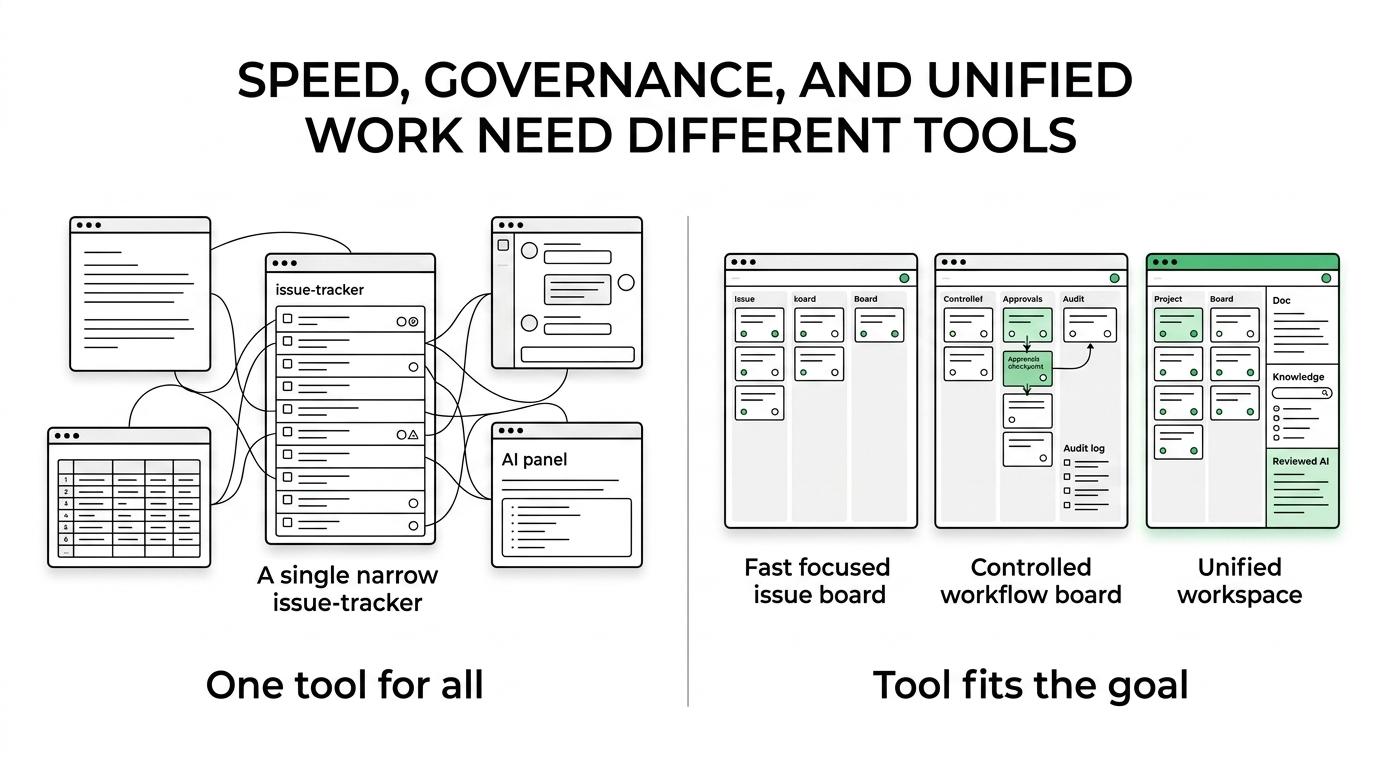
The practical difference is operational sprawl. If specs live in Confluence or Notion, issues live elsewhere, and AI reads partial context, decisions slow down. A platform that unifies those surfaces can reduce context loss. A common misconception is that AI alone fixes fragmentation. It does not. AI is only as reliable as the permissions, memory, and review model behind it.
“TOW can run self-hosted or in the cloud, which matters when a Linear alternative is being judged on data ownership, admin controls, and where AI actions are allowed to happen.”
How do ClickUp, monday Work Management, and Asana differ from Linear?
These three tools beat Linear on breadth more often than on speed. ClickUp is usually the broadest, monday Work Management is the most visual, and Asana is often the easiest cross-functional bridge.
That distinction matters because many product teams are not replacing Linear for better ticketing. They are replacing it for wider adoption across design, operations, customer-facing teams, and leadership. Forbes Advisor emphasizes resource management, workflow views, and collaboration, which is exactly where these products tend to separate from a narrower engineering tool.
After that broad market view, the differences get more specific:
- ClickUp: broad feature surface and strong resource-management orientation
- monday Work Management: visual workflow management, dashboards, and communication strengths
- Asana: cleaner adoption for non-technical teams that still need structured delivery work
If your bottleneck is portfolio visibility, monday or ClickUp may rise faster. If your bottleneck is getting non-engineering teams into one execution rhythm, Asana can be easier to roll out. If your bottleneck is engineering process discipline alone, Linear or Jira may still be the tighter answer.
How should you audit your current workflows before switching?
Start by mapping handoffs, not features. The best audit shows where context is created, where it moves, and where it gets lost across product, engineering, design, and leadership.
First, take one real initiative and trace it end to end: idea intake, prioritization, spec writing, delivery, review, launch, and retrospective. Next, identify every tool touched in that path. Then note where people copy information manually, wait for status updates, or rebuild reports.
A pro tip here is to count systems of record, not just systems of use. A team may “use” Slack daily, but the record for a decision might be a doc, ticket, or board. If no one can answer where the final truth lives, that is a switching signal.
Finish by scoring each pain point against cost: time lost, reporting friction, compliance risk, onboarding difficulty, or customer impact. If the score is high and repeated across teams, you are looking at a platform problem, not a training problem.
How should you run a 30-day pilot for a Linear alternative?
Run one live workflow for 30 days with real users, a fixed scorecard, and no side-by-side fantasy setup. A good pilot tests adoption, visibility, and reporting under normal working conditions.
In week one, recreate a current workflow with minimal customization and import representative data. In week two, run planning, specs, and delivery inside the candidate tool. In week three, bring in adjacent users from design, support, or leadership. In week four, measure what changed: cycle visibility, reporting effort, meeting load, and decision speed.
Do not ask, “Can this tool do everything?” Ask, “Can this tool reduce switching costs without creating admin debt?” That framing gets closer to time to ROI, which G2 reviewers call out directly in comparisons like monday Work Management versus Linear.
If two tools look similar at the feature level, the winner is usually the one that shortens handoffs and produces usable reporting with less cleanup.
How should you migrate issues, docs, and knowledge without losing context?
Migrate the knowledge model before the interface details. If issue history, docs, owners, and permissions do not map cleanly, the new tool can look polished while still losing decision context.
Start with objects: issues, projects, roadmaps, docs, comments, attachments, users, and permissions. Then define what must preserve identity, like ticket IDs, ownership history, backlinks, and status meaning. If your docs are tightly connected to delivery decisions, migrate those links early instead of treating documentation as a later phase.
A common mistake is moving tickets first and knowledge second. That breaks traceability. If AI or search is part of the new workspace, that problem grows, because the system may surface incomplete or outdated context. If the destination platform supports migrations from tools like Jira, Confluence, or Notion, use that path to preserve structure rather than flattening everything into CSV files.
Last, freeze a cutover date, keep the old system readable for a period, and publish a source-of-truth policy on day one. People adapt faster when they know exactly where new work belongs.
Which buying criteria matter most for startups, scale-ups, and enterprises?
Startups often win with ClickUp or TOW, scale-ups with Asana or monday Work Management, and enterprises with Jira or self-hosted platforms when governance is a first-order requirement.
Startups usually need speed, low tool sprawl, and broad functionality without a long admin ramp. Scale-ups need clearer process control, better cross-functional visibility, and reporting that leaders can trust. Enterprises add stricter identity, permissions, audit needs, and sometimes infrastructure requirements that make deployment model and data ownership central.
PMI’s 2025 findings on business acumen are useful here. Product teams are being asked to connect execution to value delivery, not just ship more efficiently. That is why workflow views, reporting, and collaboration keep showing up across G2, Forbes Advisor, and Software Advice. Buyers are not only comparing task management anymore. They are comparing how well a platform supports decisions.
A final pro tip: if the team cannot agree on the primary operating model, do not buy yet. If engineering is buying an issue tracker, leadership expects portfolio reporting, and product wants docs plus AI, the selection criteria will conflict. Clarify the operating model first, and the right Linear alternative becomes much easier to spot.