

AI workspaces pull together projects, docs, search, memory, and generative tools in one place. That combination can speed up execution, reduce context switching, and make knowledge easier to use. It also raises the stakes for data sovereignty, because the workspace is no longer a passive store of information. It becomes an active system that reads, summarizes, classifies, suggests, and sometimes acts.
For many teams, data sovereignty is no longer a legal or procurement footnote. It is an operating requirement. If an AI assistant can read roadmaps, customer tickets, internal wiki pages, and product decisions, teams need to know where that data lives, who can access it, which model can process it, and whether any action can be checked before it changes work.
Policy pressure is moving in the same direction. The European Commission opened a 2026 consultation focused on safeguarding data sovereignty and international data flows, including risks tied to third-country access to sensitive data. NIST’s AI Risk Management Framework, built around Govern, Map, Measure, and Manage, treats governance and trust as part of the design and use of AI systems. The Cloud Security Alliance has also warned that supplier-hosted LLM environments create sovereignty and shared responsibility concerns, especially when data crosses boundaries.
Data sovereignty in AI workspaces means control, not only location
A common mistake is to treat data sovereignty as a simple residency question. Teams ask whether the data is stored in the United States, the EU, or another region, then stop there. Residency matters, but it is only one piece of the picture.
Location matters, but control matters more.
In an AI workspace, sovereignty also includes who owns submitted content, which services can process prompts and retrieved context, how access rights are enforced, how long data is retained, and what happens to metadata. Even when primary files stay in a chosen region, prompts, logs, indexes, and usage traces can still create exposure if they are routed to external systems without tight rules.
A stronger definition is practical rather than abstract. A sovereign AI workspace gives a team the ability to decide what data can enter the system, where it can move, which identities can reach it, and how AI features are allowed to interact with it.
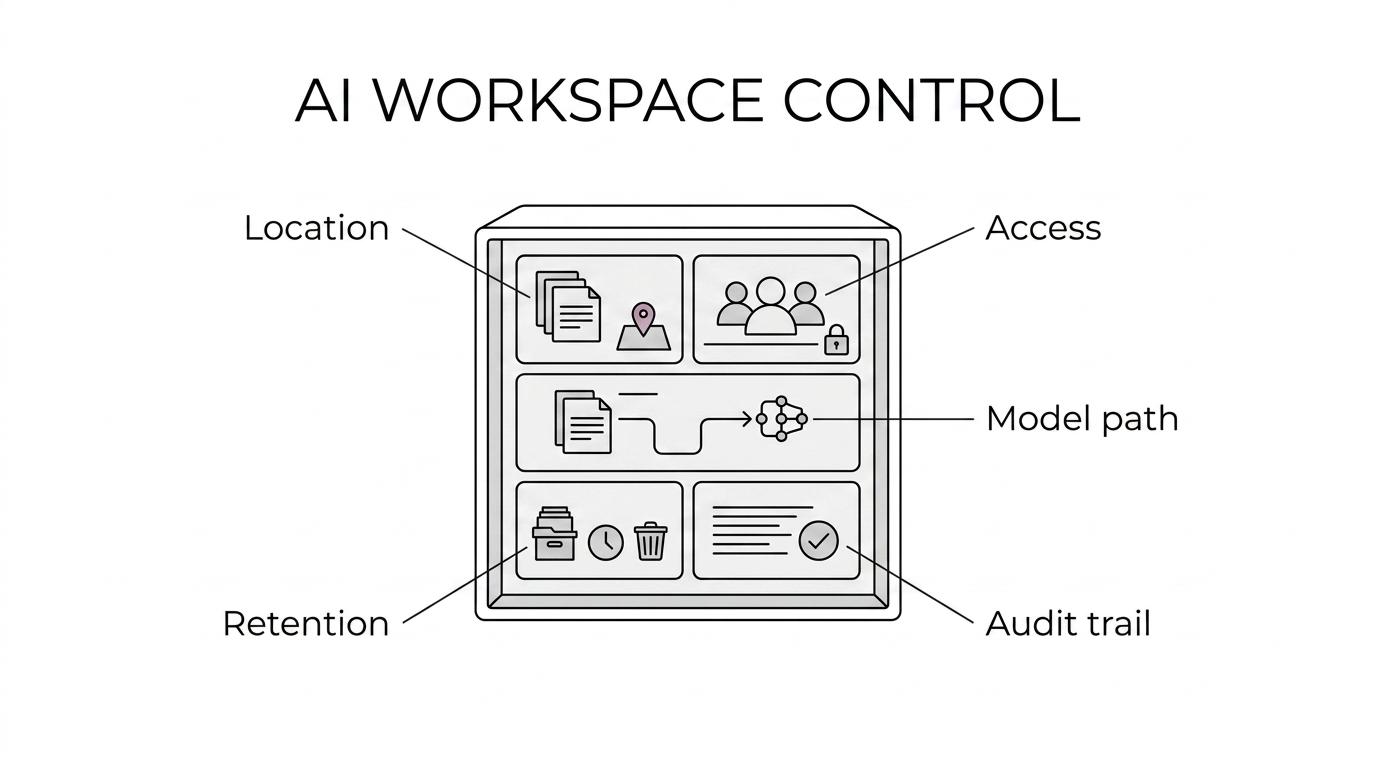
After that baseline is clear, most teams can break the topic into a few core control areas:
- Data location
- Access boundaries
- Model routing
- Retention and deletion
- Auditability
- Administrative control
AI workspace data flows create new sovereignty risks
Traditional collaboration tools already hold sensitive information. AI changes the pattern of use. A document is no longer only read by people. It may be retrieved into a prompt, summarized into a status update, cited in a planning thread, or used to suggest edits across a project.
That creates derived data, not just stored data. Teams need to think about prompts, outputs, embeddings, retrieval indexes, suggested changes, model logs, and feedback signals. Each of those can carry business value or regulated content.
This is why the sovereignty conversation often becomes more urgent right after AI is switched on. A system that seemed acceptable as a passive wiki can feel very different when it starts generating answers across multiple repositories.
The table below shows how the control surface expands once AI becomes part of the workspace.
| Workspace area | Traditional collaboration tool | AI-enabled workspace |
|---|---|---|
| Documents | Stored and edited by users | Retrieved, summarized, cited, transformed |
| Project data | Viewed in boards and tickets | Used to draft updates, classify issues, suggest changes |
| Permissions | Applied to human access | Must also apply to AI retrieval and actions |
| Logs and metadata | Activity trails for users | Added prompt logs, model usage records, inference traces |
| Review flow | Human approvals for published work | Needed for AI suggestions and automated actions |
| Hosting concerns | Storage region and backup policy | Storage region, model endpoint, data transfer path, inference boundary |
A team that ignores these extra layers may still have good storage controls while losing control over processing.
Governance frameworks give teams a practical lens for AI data controls
Many teams do not need a new philosophy. They need a repeatable way to make decisions. NIST’s AI RMF is useful here because it frames AI risk work around four functions: Govern, Map, Measure, and Manage. That structure fits data sovereignty well.
Govern means assigning responsibility and setting policies before deployment. Map means identifying what data is used, where it flows, and which business risks matter. Measure means testing whether controls are actually working. Manage means updating operations when risks change, models change, or the organization’s obligations change.
The European Commission’s recent consultation adds a second layer of urgency: data sovereignty is tied to international data flows and possible access from outside the team’s legal and operational boundary. The Cloud Security Alliance adds a third point: when data is hosted in a supplier’s LLM environment, the team is working inside a shared responsibility model, not full infrastructure control.
That turns sovereignty into a governance discipline, not a procurement checkbox.
A practical way to apply those frameworks inside an AI workspace looks like this:
- Govern: define ownership, approval rights, retention rules, and approved AI use cases
- Map: catalog documents, tickets, prompts, outputs, logs, and any external model endpoints
- Measure: test permission boundaries, audit trails, deletion behavior, and access reviews
- Manage: update controls when teams, vendors, regulations, or model policies change
Self-hosted and single-tenant AI workspace architecture changes the control model
Architecture shapes sovereignty. If an AI workspace runs inside a vendor-controlled multi-tenant environment, the team depends on the vendor’s infrastructure choices, service boundaries, and internal control practices. That model can still be viable, but the trust assumptions are different.
A self-hosted or tightly isolated single-tenant design shifts more of that control back to the team. The organization can choose the region, network controls, identity provider, backup policy, model endpoints, and retention settings. That does not remove responsibility. It changes where responsibility sits.
This is one reason many teams prefer workspace platforms that support self-hosting, BYOK options, and permission-aware AI actions. In a design like TOW’s, the workspace can unify projects, docs, memory, and reviewable AI while remaining on infrastructure the customer controls. That can make data ownership, administrative control, and deployment boundaries much clearer.
Reviewability matters as much as hosting.
If AI can suggest changes to docs, classify issues, or draft answers using workspace context, those actions should stay visible and subject to human approval when the risk level calls for it. A review loop does not slow down good work. It creates a record of what the system proposed, what data it used, and what a person accepted or rejected.
Operational discipline is part of sovereignty too. Self-hosting is not a magic shield if access management is loose or deployment secrets are weak. TOW’s own security guidance makes this point directly: security depends on correct configuration, disciplined access management, and clear handling of AI-connected data. Even a basic setup item like an application secret needs care. Their docs specify setting APP_SECRET to a long random value from an approved secrets manager before first boot, which is a good example of how sovereignty depends on operational habits, not only architecture.
What teams should require from an AI workspace platform
A serious AI workspace should be ready for detailed questions. If a vendor cannot explain where prompts go, what is retained, how permissions are enforced, or how AI actions are reviewed, that is a signal in itself.
Strong teams also look past marketing language. “Private AI” can mean many things. “Customer-owned data” can still leave unanswered questions about inference logs, metadata, temporary storage, and model-provider access. As Prima Secure’s explainer on what zero trust security means for modern teams makes clear, continuous verification, least‑privilege access, and strong segmentation clarify how inference logs, metadata, and transient stores should be governed across the stack.
The most useful evaluation criteria are concrete:
- Data ownership: the contract should state that customer content, prompts, comments, tickets, and documents remain the customer’s
- Hosting options: cloud, self-hosted, or single-tenant paths should be clear rather than implied
- Permission-aware AI: the system should respect workspace access controls when retrieving context
- Model boundary clarity: teams should know which model endpoints are used and when data leaves the primary environment
- Human review: suggested actions should be reviewable before changes are applied in sensitive workflows
- Admin controls: identity, audit logs, retention settings, and policy enforcement should be visible to administrators
These requirements are especially relevant when the workspace becomes the company memory layer. Once AI can answer questions across years of decisions, incident notes, customer issues, and product plans, the platform is handling far more than “documents.”
A practical rollout plan for AI workspace data sovereignty
Most organizations do not need to solve everything on day one. They need a rollout plan that starts with classification and ends with operating discipline.
Start by separating data into groups. Public or low-risk planning material can often live in a standard cloud setup. Customer records, regulated data, internal strategy, legal work, or security investigations usually call for tighter hosting and stricter review controls. That split helps teams avoid treating all information as equally sensitive.
Next, define the AI boundary. Decide which repositories AI can read, which actions it can take, and whether external models are approved for any of those tasks. Some teams allow summarization in project spaces but keep legal or incident response material out of retrieval entirely. Others allow AI drafting but require human approval before publishing or updating tasks.
Then put the policy into operations.
- Classify workspace content by sensitivity and business impact.
- Choose the hosting model that fits each class of data.
- Apply permission-aware retrieval and role-based access controls.
- Turn on review steps for AI actions that can change records or decisions.
- Audit prompts, outputs, logs, and endpoint usage on a schedule.
It also helps to assign a single owner for AI workspace governance. Without that, policy tends to scatter across security, legal, procurement, and platform teams, leaving gaps in the places where real work happens.
A well-run AI workspace should let teams move faster without giving up authority over their own information. Data sovereignty is what turns that promise into something durable: clear boundaries, reviewable actions, documented rules, and infrastructure choices that match the organization’s risk profile. When those pieces are in place, AI becomes much easier to trust inside the systems where teams actually work.