

AI agents are moving from draft assistants to active participants in team workflows. They can summarize meetings, propose issue updates, rewrite docs, open tasks, and connect signals across systems. That reach is valuable, but it also changes the risk profile of everyday work. The question is no longer just whether an agent can produce useful output. The bigger question is whether a team can inspect, review, and control what happens before changes become real.
A reviewable agent model gives a practical answer. Instead of letting an agent write directly into important systems by default, it separates generation from acceptance. People keep decision rights. Context stays visible. Proposed changes can be accepted, rejected, or revised. When this review flow is built into the workspace, teams can move faster without giving up accountability.
This approach fits well with public guidance on AI risk. NIST describes several human-AI configurations, from systems that act autonomously to systems that support human decision-makers. OECD has also emphasized incident monitoring as AI use expands. Together, those ideas point to a simple design principle: the more consequential the action, the more important it is to keep review, traceability, and permissions in the loop.
Why AI agent autonomy changes workflow risk
When an AI agent shifts from suggesting work to performing work, risk moves closer to operations. A bad summary is inconvenient. A bad summary that updates a customer-facing policy page, changes a roadmap, or closes an issue can create confusion, delay, and rework. In many teams, the real concern is not a dramatic system failure. It is a long series of small, plausible mistakes that slip into accepted work.
NIST has warned that human-cognitive biases are present across the AI lifecycle and can be amplified when systems are opaque. That matters in daily team use because people often trust fluent output too early. A 2024 study in Cognitive Research: Principles and Implications found that incorrect AI support reduced human judgment accuracy, especially when people saw the AI suggestion before making their own judgment. In practice, that means review design matters as much as model quality.
Speed without review is not the same as productivity.
A few workflow risks show up again and again when AI agents move too quickly from suggestion to action:
- Premature acceptance
- Hidden context gaps
- Overbroad permissions
- Missing audit trail
- Silent write-backs: changes land in systems before anyone checks them
- Automation bias: people accept plausible output because it arrived first
- Diffuse ownership: nobody is sure who approved the action
- Weak recovery: teams cannot reconstruct what happened after a mistake
How reviewable AI agent workflows change the control model
A reviewable workflow starts with a clean separation between proposal and acceptance. The agent can draft, summarize, classify, or recommend, but consequential actions are routed into review instead of being written back directly by default. That shift sounds modest. It is actually a major control point.
In TOW’s AI flow, that separation is explicit. Permission-aware retrieval pulls context the user is allowed to access, configurable agents generate proposals, and those reviewable proposals move into a review step before acceptance. The path remains inspectable from source to accepted change. Teams can see what the agent used, what it suggested, and what a human approved.
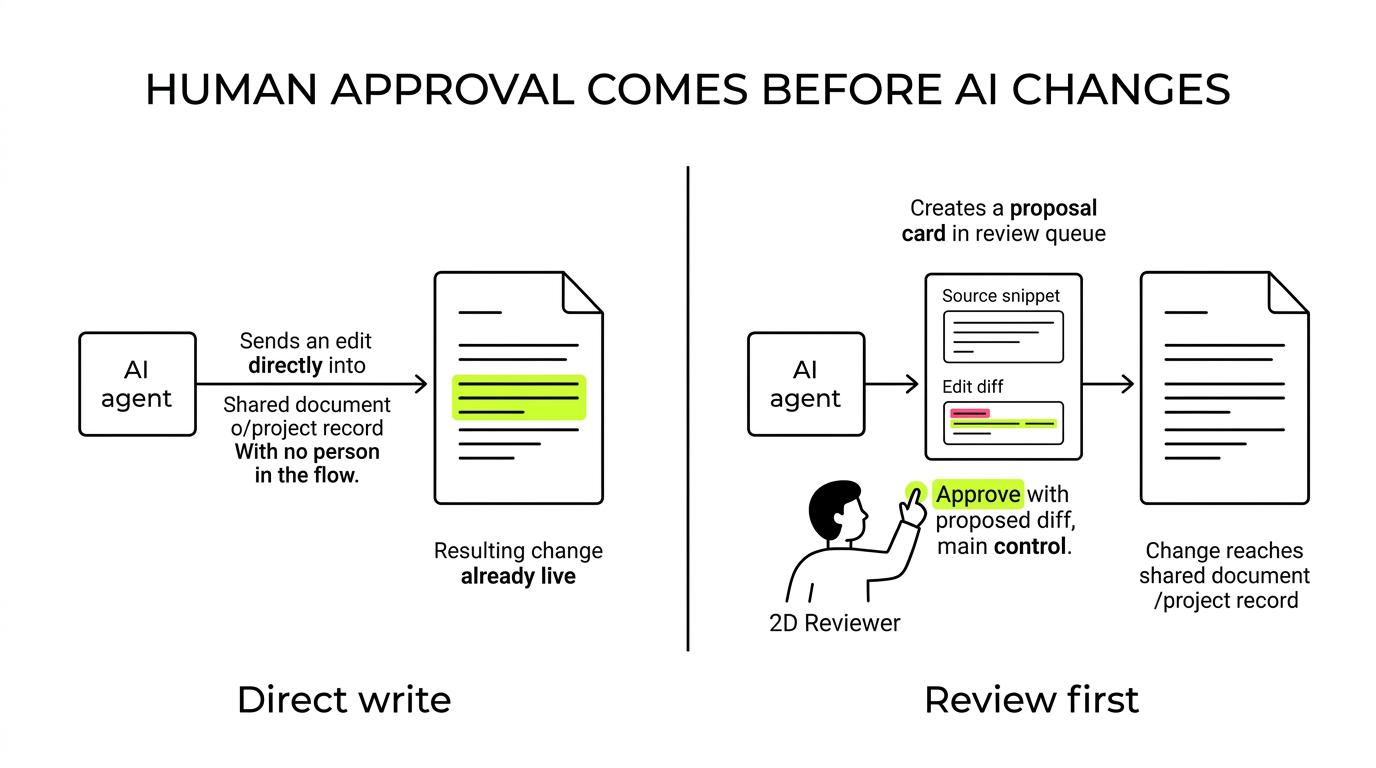
This model works well because it matches how strong teams already manage operational change. Code gets reviewed. Contracts get checked. Policy edits get approved. AI output deserves the same treatment when the output can alter shared records, plans, and memory.
The table below shows how the two operating models differ.
| Workflow characteristic | Direct-write agent path | Reviewable AI agent workflow |
|---|---|---|
| Default action | Writes changes immediately | Proposes changes for review |
| Human role | May notice problems after the fact | Accepts or rejects before changes apply |
| Visibility into context | Often limited | Source, reasoning, and proposed diff can be inspected |
| Permission handling | Risky if scope is broad | Stronger when retrieval is permission-aware |
| Traceability | Harder to reconstruct | Proposal history supports later inspection |
| Operational fit | Best only for narrow, low-risk tasks | Better for most cross-team workflows |
Human oversight works better when context is visible
Human review only works if reviewers can actually judge what the agent did. A vague draft with no context does not create real oversight. It creates a rubber stamp. Good reviewable systems expose the ingredients of the proposal: the source material, the intended action, the affected objects, and the diff or before-and-after view.
That is one reason permission-aware retrieval matters. If an agent gathers context from projects, docs, and company memory, reviewers need confidence that the context was both relevant and properly scoped. Review becomes stronger when people can see where the information came from and whether anything important is missing.
NIST’s point about human-AI configurations is useful here. AI can act as an additional opinion, a deferred recommendation, or an autonomous system. For team workflows, the safest and most effective configuration is often one where the AI provides a structured proposal and the human makes the final call. That setup reduces the chance that confident language will overpower careful judgment.
Reviewable workflows are strongest when they make these controls easy to use:
- Visible sources: reviewers can inspect the materials behind the proposal
- Clear diffs: changes are shown as edits, not vague summaries
- Explicit decisions: accept and reject are recorded, not implied
- Scoped permissions: the agent only accesses what the reviewer could access
- Fast triage
- Reversible actions
- Shared queue ownership
Permissions and data ownership are part of AI risk control
Teams often talk about AI risk as a model problem, but a large part of the risk sits in access control. If an agent can pull from more systems than a person should see, or write into more places than a role should modify, the workflow becomes unsafe even when the generated text looks reasonable.
That is why permission-aware retrieval is more than a feature. It is a boundary. An agent should operate within the same access model that already governs projects, docs, and internal memory. When permissions are inherited from the workspace, the system is easier to trust because it reflects existing governance rather than creating a parallel, opaque access layer.
This is also where infrastructure choices matter. Some teams need cloud convenience. Others need self-hosted control, stronger admin controls, or a bring-your-own-key setup for AI endpoints. The shared principle is simple: the team should know where the data lives and who can act on it, and how to review changes before those changes affect the wider organization.
A unified workspace helps because it reduces handoffs between disconnected tools. When projects, documentation, memory, and AI actions live in one environment, permissions and review rules can stay consistent across the whole workflow.
Incident monitoring and proposal history help teams learn
Review reduces risk before a change lands. Monitoring reduces risk after patterns begin to appear. Both matter.
OECD has warned that AI incidents and hazards are increasing as adoption grows, and it has pushed for incident reporting and monitoring that can work interoperably globally. That message applies inside organizations too. Teams need a way to spot repeated failure modes, not just fix one bad output at a time.
A review inbox is a strong operational pattern here. TOW uses a review inbox to collect pending AI review items in one working queue, making it easier to triage proposals, assign reviewers, and keep important changes from slipping through. Just as important, proposal history remains available for later inspection. If a problematic update was accepted last week, the team can trace what was proposed, who approved it, and what context was used.
That history turns mistakes into process improvements instead of recurring surprises.
When teams look back at accepted and rejected proposals, they can improve the agent system in concrete ways:
- Tighten scopes: narrow which tasks qualify for agent support.
- Refine prompts and tools: reduce recurring error patterns in summaries, classifications, or edits.
- Set review thresholds: require stronger review for policy, legal, customer, or roadmap changes.
- Track incident classes: group issues by source, impact, and recovery effort.
Where a narrow direct-write AI agent path can make sense
Reviewable by default does not mean every action needs a person in the loop every time. Some work is repetitive, low-risk, and easy to validate with strict guardrails. In those cases, a narrow direct-write agent path can be reasonable if an administrator explicitly enables it and the scope stays tightly bounded.
Good candidates are usually tasks where the cost of a wrong action is low, the validation rules are clear, and the agent is not making open-ended judgment calls. Think of metadata tagging, routine formatting, or status synchronization between already approved records. The key is that the path remains narrow and observable.
The moment a task can change meaning, ownership, commitments, or policy, review should return.
A practical checklist helps teams decide where direct write is safe and where review should stay mandatory:
- Good candidates: formatting fixes, duplicate detection, low-risk tagging
- Needs review: roadmap edits, policy updates, customer-visible text, issue closure
- Admin control: direct write should be explicitly enabled, never assumed
- Fallback path: every automated action should still be inspectable after execution
What strong reviewable AI agent systems look like in daily team work
The best reviewable agent systems do not slow teams down with friction for its own sake. They remove hidden risk while keeping work moving. Review items appear in the same place people already manage projects and docs. Context is attached to the proposal. The decision is clear. The history is preserved.
That design also improves trust across teams. Writers know AI suggestions will not quietly rewrite published docs. Product teams know roadmap changes will not appear without owner review. Operations teams know agent access follows admin rules. Security teams know there is a record of what happened. The result is not just safer AI. It is a more dependable workflow.
For organizations adopting agents across shared work, that is the real win. Reviewable proposals preserve human judgment, permission-aware retrieval keeps access within bounds, and proposal history makes decisions inspectable long after the moment has passed. When those controls are built into the workspace, AI becomes easier to use at scale because the system respects how accountable teams already work.