
Product teams move faster when roadmap planning and documentation live in the same system as delivery. TOW builds The Only Workspace, a unified platform for project management, docs, company memory, and reviewable AI that you can run on your own infrastructure or in the cloud.
If you are tired of splitting roadmap items, specs, tickets, decisions, and research across separate tools, TOW gives you one controlled workspace to plan work, document context, and keep product teams aligned as execution moves forward.
TOW roadmap software and documentation keep product context connected to delivery
TOW is built for teams that want roadmap records and docs to be connected workspace objects, not separate tools that drift apart over time. That means your goals, roadmap items, tickets, notes, and decisions stay easier to trace as work moves from planning into implementation.
That connection matters because requirements quality often depends on communication quality. According to PMI, when inadequate or poor communication is a primary cause of project failure, three out of four organizations say it harms requirements management more than any other area. TOW is designed to reduce that gap by keeping product context inside the same workspace as execution.
“TOW is built for the gap PMI highlights: 3 out of 4 organizations say communication failures hurt requirements management most.”
With TOW, your team can search, collaborate, and follow delivery without constantly reconstructing context from scattered boards, wiki pages, and disconnected notes. We keep docs, tasks, decisions, risks, projects, and AI-assisted work together in one private workspace so the record of why something matters is easier to keep close to the work itself.
Product teams use TOW for roadmaps, specs, wiki documentation, and delivery tracking
TOW helps startups, growth-stage companies, and enterprises that need more than a standalone roadmap board or a separate documentation tool. Product managers, engineering leads, and operations teams use TOW when they need strong admin controls, clear data ownership, and a shared operating record.
TOW combines planning and documentation in practical ways that product teams use every week. You can collect requests, write specs, plan roadmap work, record decisions, and follow delivery without moving between separate systems.
Here is what that looks like inside the workspace:
- Roadmaps, issues, boards, goals workflows, and custom fields for planning and tracking work
- Docs and wiki pages for product briefs, strategy notes, customer research, implementation notes, technical plans, architecture context, onboarding material, and meeting notes
- Search, collaboration, notifications, explicit references, and backlinks so related work is easier to find and follow
- Document-level access controls for explicit members and teams when some material should stay limited
- Ticket conflict review and project templates such as epic roadmap planning, story design-to-delivery, QA verification, release readiness, and change approval
TOW Docs also supports Markdown import, which helps when your team already has written knowledge that should not be recreated by hand. For teams replacing fragmented workflows, that makes consolidation more realistic and less disruptive.
Reviewable AI for roadmap updates, documentation changes, and team memory
TOW includes workspace-aware AI agents that can work with the context already inside your workspace. They can propose memory changes, tickets, roadmap changes, and snapshot text, and TOW recommends human review before acceptance so your team stays in control of what becomes part of the record.
“TOW can propose memory changes, tickets, roadmap changes, and snapshot text, with human review before acceptance.”
That review model matters if you want AI help without silent edits or unclear ownership. TOW combines permission-aware AI actions with either BYOK or TOW-managed AI endpoints, giving your team a practical way to use AI assistance while keeping admin decisions, data boundaries, and approval expectations explicit.
TOW is a strong fit when you want AI to accelerate product operations, not bypass them. Instead of asking a generic assistant to guess at roadmap intent, your team works with AI inside the same workspace where docs, tickets, and prior decisions already live.
Self-hosted or cloud roadmap software with admin controls and data ownership
TOW gives you a deployment choice that many product teams actively need: self-hosted control or a cloud workspace. If your organization has infrastructure requirements, data ownership concerns, or tighter admin expectations around internal knowledge and product planning, TOW lets you keep the system closer to your standards.
“TOW offers one workspace you can run self-hosted or in the cloud, with document-level access for explicit members and teams.”
That control extends beyond hosting. TOW includes admin, auth, migrations from Jira, Confluence, and Notion, plus document permissions that help you manage who can access sensitive planning notes, technical context, or internal operating material.
For smaller organizations, TOW also offers a free self-hosted tier. That makes it easier to start with a controlled workspace before committing to a larger rollout.
TOW helps teams replace fragmented Jira, Confluence, Notion, and Linear workflows
Many teams do not struggle because they lack tools. They struggle because roadmap software, docs, and delivery records are spread across too many tools with weak connections between them. TOW is built for teams that want one workspace to do the work and preserve the context around it.
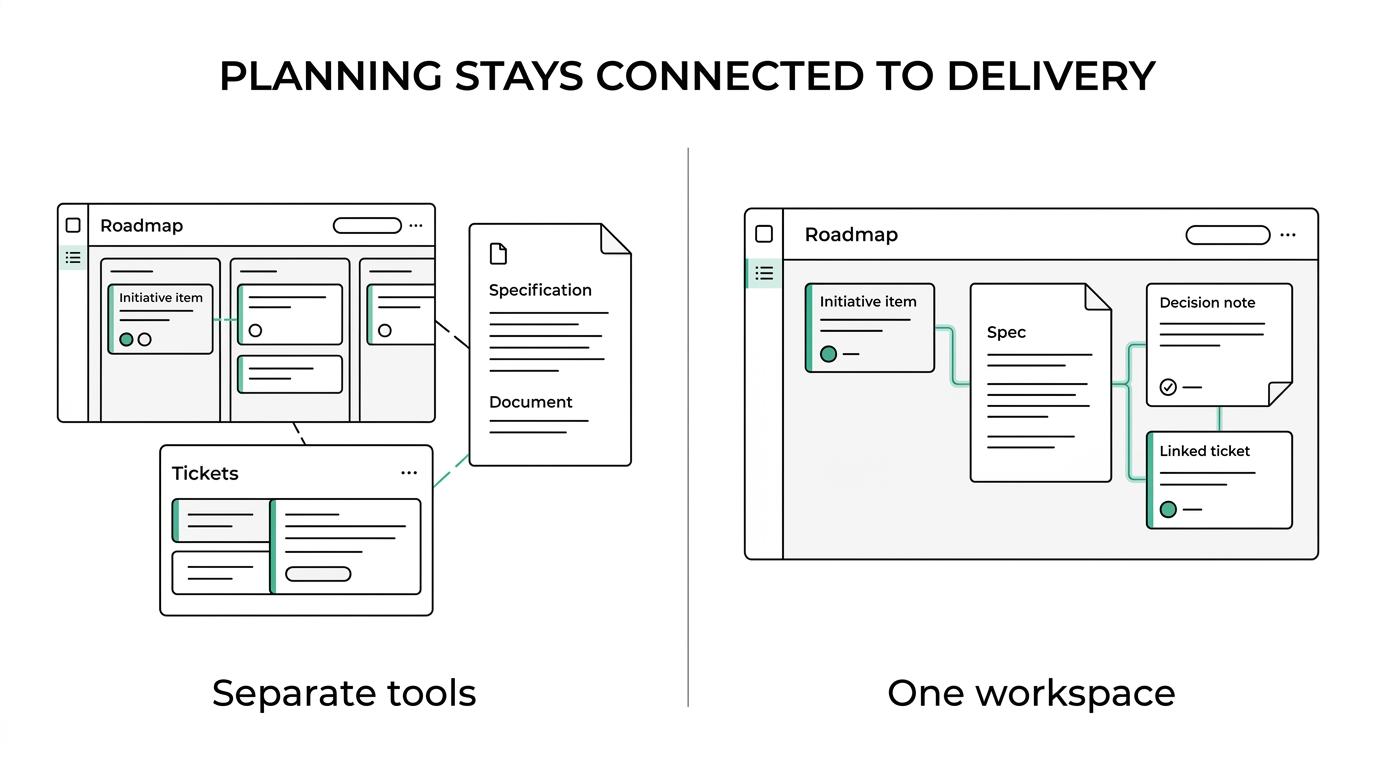
TOW is likely a strong fit if these problems sound familiar:
- Your roadmap, specs, and tickets lose alignment once execution starts
- Your team wants docs to be part of delivery, not a separate destination
- You need self-hosted deployment or stronger control over data ownership
- You want AI assistance that respects permissions and supports human review
- You are consolidating from Jira, Confluence, Notion, Markdown docs, or similar tool combinations
If you only need a lightweight task board and do not care much about documentation, permissions, or workspace memory, TOW may be more system than you need. But if your team depends on documented requirements, traceable decisions, and a roadmap that stays tied to actual delivery, TOW is built for that operating model.
Start using TOW for roadmap planning and documentation in one workspace
When your roadmap, docs, tickets, and team memory stay connected, planning gets clearer and execution gets easier to trust. TOW gives product teams one workspace to write specs, shape roadmaps, review AI-assisted changes, and keep delivery context intact.
If that is the system your team has been missing, explore TOW and set up the workspace model that fits you best, self-hosted or in the cloud.